Frozen Time: Transcending Evanescence Through Art


Under the vaulted historical legacy of Mogoșoaia Palace, the exhibition "Frozen Time: Transcending Evanescence Through Art" functions as a curated dialogue between two distinct yet converging visual languages. As the curator of this duet project, my objective was to orchestrate a space where the ephemeral nature of human experience meets the permanence of artistic expression.
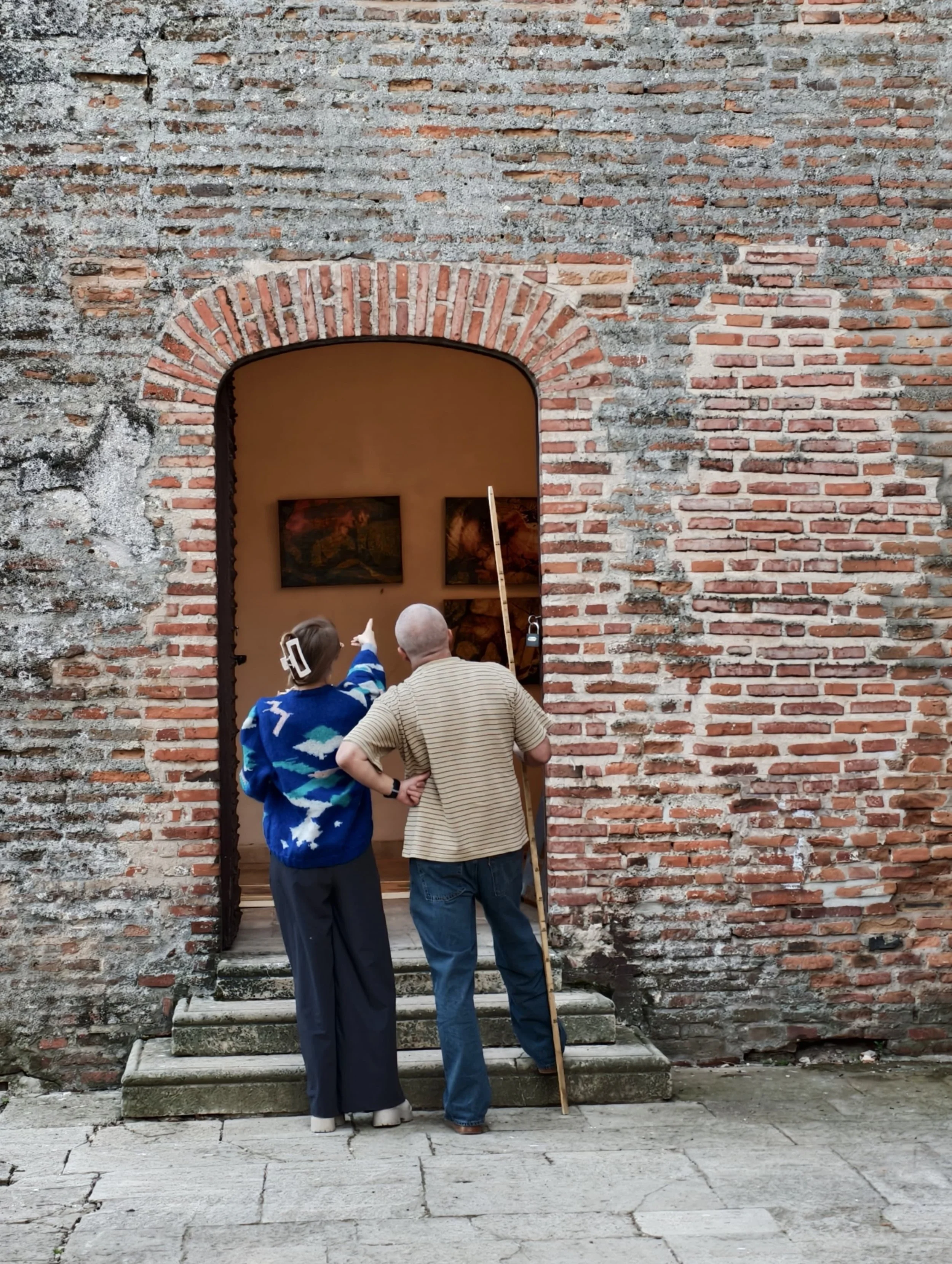
The exhibition explores the suspension of the "moment" — that fragile, fleeting slice of time that art has the unique power to solidify. By bringing together the works of Rebeca Emanuella Mănescu and Cătălin Velcea, the curatorial direction focused on the tension between presence and absence, shadow and light. My role was to weave a narrative thread between Mănescu’s structured visual explorations and Velcea’s evocative sensitivities, creating a cohesive journey through the layers of memory and transience.
In the unique architectural context of the Palace, "Frozen Time" was not merely a display of objects, but a curated atmosphere—an invitation to witness the alchemy of time as it becomes still.

Frozen Time: Transcending Ephemerality Through Art
„Faced with the passage of time, with the ephemeral and the fragility of life itself, the human being has two deeply visceral possible responses. One consists of transmutation through acceptance — embracing this nature of things as a generative force for creation and renewal. The other is one of opposition and transmutation through the search for, and discovery of, means capable of preserving, of suspending existence within an atemporal plane. Both carry profound meanings and their own form of quiet wisdom.
The two artists meet at the intersection of this second, preservative response and the use of photographic techniques as a plastic vehicle. Although their motifs and formal articulations differ, their ultimate aim is the same: the freezing in time of evanescence — the visual moment, the fragile organic form subject to decay. Their shared creative discourse is grounded in a rigorous and structured exploration of these processes. Their limits are shaped and tested, while their pulsating expressive capacity is pushed to its fullest potential.
Starting from the figurative realm, they gradually depart from it, entering a domain of synthesis that extends even into the non-figurative. Here, the full force of transmission toward the viewer is carried by the expressive qualities of technique and the signs of visual language, while the key to decoding meaning is conceptual rather than familiar or recognisable. The mundane becomes a vast ocean, within which the lens of creative perception searches for and identifies a spark — a flicker of a moment, an emotion, a light — capturing it and situating it within a metaphysical context, accessible without limit to both viewer and artist.
Reality is filtered through a deeply personal lens, absorbed into a blend of memories, emotions, impressions, and technical interpretations shaped by diverse influences. This synthesis constitutes the unique imprint of each artist.
A significant aspect worth emphasizing, in the context of the 2020s, is the attention that Rebeca Emanuella Mănescu and Cătălin Velcea dedicate to the hybrid dimension of photographic practice through analog post-processing. In a moment when AI generates images instantly, reducing human contribution to that of co-creator or prompt-giver, and when instant gratification plays an increasingly central role in artistic practice, the two artists remain committed to meticulous, tangible processes with strong painterly qualities — such as photo transfer.
In doing so, they reveal an inner axis aligned with their visual discourse, entirely devoted to bringing the ephemeral into the realm of permanence. In a nuanced way, their preferred means of preservation carries a dual character, traversing the transient-stable binomial. The irregular edges and subtle imperfections resulting from the friction of paper during printing underscore the fragility of the subject — yet one that ultimately endures.
Rebeca Emanuella Mănescu approaches the often-visited motif of the rose with an authentic, deeply personal, lucid, and unconventional vision. While the floral element may initially appear accessible, her angle of inquiry is far from facile. The architecture of the image unfolds both conceptually and materially in sequences, encompassing a wide range of hybrid processes and material states. The supremacy of the visual sign — of distilled form and its geometrization — displaces the subject itself within the composition. The subject becomes merely the germ of conceptual contemplation, the impulse that crystallizes an attitude toward the creative process as a whole, and a field from which visual signs — predominantly lines, but also marks — are gathered, relating and rhythmically interacting in unique, unrepeatable ways, captured by the retina for only a moment, yet preserved within the work. In this sense, particular emphasis is placed on procedural mastery and the layered construction of the image.
The stability and painterly consistency of the transferred image represent only the final stage — the visible tip of a complex visual stratigraphy. Prior to this, a spectacular and experimental display of supports unfolds, chosen for direct intervention within nature. In accordance with the fragile and transient symbolism of the rose, precarious organic surfaces — subject to the whims of time — are selected as receptacles: snow, rose petals, dry soil, and tree bark.
The nature of intervention varies creatively, from reed-drawn lines to ink, charcoal, and sanguine. The essentialized expression of the flower is then captured on film, acquiring the status of a new type of image. Through further processing, its morphology is distilled even further, reconfiguring its meaning. No longer a simple two-dimensional projection, it undergoes photographic printing, acquiring material density and a hybrid texture where light imprints fuse with the irregularities of the new substrate. Through this transition, the image abandons the perfection of the virtual plane, with photo transfer functioning as an act of re-incarnation of form. Moreover, in order to enrich this palimpsest of conceptual and material layering, the work “Snow Roses” is completed through a final stage: chromatic intervention using hand-prepared mineral pigments, returning the work to the organic sphere from which it originated.
The complexity of her vision manifests not only vertically — conceptually and technically — but also horizontally, through integrated influences and references. One can discern an embrace of East Asian aesthetics, particularly Korean tradition. The writing system of ideograms — composed of firm lines that evoke autonomous abstract images beyond explicit verbal meaning — resonates strongly within her work. This same visual script emerges in her interpretation of the rose. As she herself has noted, the vision of this exhibition was born during the graduation ceremony of a Korean painting and calligraphy course.


Cătălin Velcea, in turn, evokes and intertwines vegetal and organic forms across multiple levels, sharing this direction of exploration with Rebeca, yet diverging through a complete departure from figuration. Using the polymorphism and relief of bark as his subject, his photographic approach unfolds through a stratigraphy of overlapping frames, granting the final image a hypnotic depth and remarkable evocative force. These works evoke archaic tribal pulsations, the flutter of butterfly wings, or the crystalline structure of amber — derived from tree sap that, much like photography, captures and preserves in eternity what it contains. Within these visual layers, vegetal ephemerality is alchemized into symbolic matter, sediment of memory and passage. Wood transforms into skin, mineral relief, geological memory. Nature is no longer merely represented, but transmuted — from living to perennial, from fragile to archetypal.
Visually, the superimposed frames, breathing through transparency, create a sinuous rhythm. Lines glide over one another, generating a continuous metamorphosis of contours that vibrate in an uninterrupted flow, oscillating between presence and dissolution. Their ductus imbues the work with pulsating vitality, transforming the static image into a living visual organism. Meaning is not something discovered externally, but projected outward and reflected back, shaped by the surrounding urban reality. From proximal chaos, the artist generates order and new layers of meaning.
Photography ceases to be a mere instrument of representation, becoming a laboratory of metamorphosis instead. Moving beyond documentation, Cătălin Velcea employs an alchemy of superimpositions that reassemble space into a new visual syntax. This method acts as a filter through which dense chaos and the banal are purified, allowing only a structural essence of vegetal origin to emerge. The resulting image resists immediate comprehension, requiring contemplative reading, inviting the viewer beyond the surface of the light imprint, where organic matter and spirit fuse into an inseparable plastic entity.
Within this laboratory of intercalations, the analog printing of digital imagery acts as a bridge between the visible and the tangible. The granulation of laser print and the irregularities of transfer become the very flesh of the image. Through this method, Cătălin Velcea captures not merely form, but a memory of matter, where the unpredictability of chemical processes merges with compositional precision into an aesthetic of trace. Photo transfer becomes an identifying mark of his work, transforming binary photonic rendering into a dense body capable of preserving the visceral charge of botanical ephemerality.”
Andreea-Eliza Petrov, curator